
Alpine Ethos #6: New guidebook threatens to change Old Stage climbing— for the better.

Updated: Aug 5
The Stage

You never forget your first. There’s the first girlfriend, or boyfriend, of course. And your first car, which is special, even if it’s a bucket. For many in the Springs area, Old Stage Road is the first, and quickest, trip into the mountains they take. The winding dirt road, rounding treacherous corners, reveals glimpses of a lifetime of rock through the trees. When I first moved here from the flatlands, back in December of 1997, it was the first road I wanted to check out with my used 4X4 Isuzu. Some Army buddies and I camped out behind Mount Rosa along an old logging road. We stashed beers in a snow bank and built a raging fire. Quite an adventure for an Oklahoma kid.
Aside from the beauty and potential for exploration, there’s also the weird side. Wrecked cars litter many of the draws below the corners, and gun owners with questionable experience and safety principles blast trees and rusted kitchen appliances right next to the road. Back in ’98, a friend and I came across a jeep that had been flipped over on the road. The lights were on, but no one was in sight. We figured it had been stolen, joyridden, then ditched. The forest service has found itself in a continuous war with mobile drug labs, rogue shooters, and the occasional homicide. But, for the most part, things are pretty tame during the daylight hours, and you’ll mostly just find climbers, mountain bikers, sight-seers, and jeepers.
A highly anticipated new guidebook for climbing on Old Stage Road is dropping soon (late August-early September). After years of exploring seldom-visited areas, documenting forgotten lines, and establishing dozens of routes of their own, Sam Jones and Dakota Millard are putting the final touches on their 120-page manuscript that will spray locals with over three hundred climbs.

If you’ve ever talked to an old-head about climbing on The Stage back in the day, you’ve likely heard stories of getting lost several times before they found the goods, with extra credit given for trespassing and getting away with it. Wasting some gas and getting lost in the woods was just part of the process, according to some. One such character (curiously, only a few years older than myself) once bragged to me about toproping Hully Gully back when it was private property, then lamented that the city had acquired the property and now all these soft youngsters could hike a trail to the base with their mountainproj beta. But
with this new guidebook, Sam and Dakota hope to preserve the story of the olden days, while also helping to usher in a new chapter for the area, one that fosters a more responsible group of users than currently exists.
Past is Prologue
Steve Cheyney, now eighty years young, was there in the beginning. Finding climbing partners in the Springs was so tough back in the early sixties that Harvey Carter founded his own group, called the TCC (The Climber’s Club), to encourage climbing in the area. Members met once a month and showed slides and stories, and maybe a few lies, about their exploration. So little had been climbed at that time that almost every climb was a first ascent.

Steve’s first partner was both a strong climber and a talented artist named Peter Croff. You can spot his name in the FA line of many local guidebooks, but his paintings were even more inspiring than his routes. By all accounts, he was a visionary who could craft natural light with his brush, leaving one truly in awe of his abilities. Unfortunately, Peter suffered from debilitating mental health issues as he aged. Harvey Carter once told me the story of a trip he took with Peter to climb a new route in Glenwood Canyon. They camped along the road and planned to push a new line to the top at daylight. However, Harvey awoke to an empty camp. Peter had driven away unnoticed in the middle of the night, leaving Harvey to hitchhike home. Years later, Peter took his own life.
Steve and Peter explored new routes in the Old Stage area in the early 1960s to include a bushy line in Cathedral Park, as well as one of the most classic crack climbs of the Front Range, The Martyr, on the craggy north side of St. Peter’s Dome.
Steve Cheyney went on to open his own climbing and shoe repair shop in Old Colorado City. The Cobbler was the nexus of the Colorado Springs climbing community during the golden age of the late sixties to late seventies. Legends like Jimmy Dunn, Bryan Becker, Stewart Green, Ed Webster, and Earl Wiggins, to name a few, hung out to trade beta and smoke joints.
In 1980, Mark Van Horn and Kerry Gunter were finishing up high school. They were much younger than the crowd at The Cobbler, but they were ambitious and adventurous. It took several trips for them to find the Martyr, but they eventually spotted it. By that time, The Martyr’s perfect cracks held so many pitons left behind from ascents that it was practically a clip-up. After finding and sending the route, they began to explore lines of their own. In 1981, Mark teamed up with Kerry Gunter to aid a new route near St. Peter’s Dome in the dark. Kerry was a strong kid, looking more like a college linebacker than a rock climber.
Bob Couchman was an active climber (and a Coronado High School English teacher) in the area back in the 80s and 90s. Bob told me about climbing with Kerry in those days. “He rarely backed off anything. And if he couldn’t make the moves, it was a waste of time for most people to even try.” Kerry was a force of nature, especially in the Black Canyon, where he established countless new hard routes, as well as setting speedy times on classics like the Scenic Cruise.
Mark and Kerry topped out their new line that night around two or three in the morning, and they couldn’t get their car started when they got back. They were left with no other choice but to walk the eight miles to the Broadmoor and call for a ride.
Mark went away to college but returned in 1986 just as sport climbing was gaining steam. He spent much of the late 80s developing routes in a newly discovered playground an hour and a half south of Colorado Springs, a venue that would transform sport climbing in Colorado. A handful of climbs had been done at Shelf Road, placing passive gear in pockets, but it took the battery-powered drill to tap the true potential of those endless limestone cliffs. “I was grateful to fall under the wing of Daryl Roth and began helping him establish routes early. And there began my interest in opening routes.”

Mark not only established some of the most classic lines linking sharp, limestone pockets, but he also wrote and published the first guidebook for Shelf Road. When Mark returned to Old Stage in the early 90s to run a lap on the Martyr, he saw the place with new eyes. He could now envision lines linking features across the once unprotectable faces.
Athenian Arete (12a) and The Oracle (11+) are true standouts of the St Peter’s Dome area. Both routes possess impeccable rock, outstanding position, and enough distance between bolts to keep you honest. “I didn’t think it was gonna go over well when I bolted them. But no choppers came. I was surprised.”
A New Chapter
There are no rules or regulations for writing guidebooks. However, for a person to do it well, a few things are a must. The first, of course, is familiarity with the area. Getting the beta right requires an intimacy with the terrain that only comes after getting lost a few times. Another is credibility with the community. This doesn’t necessarily mean you’re the hardest climber, but that you’re honest and kind to others. Others need to know your word means something. A third, little acknowledged factor is humility. Just as important as your knowledge is the ability to admit what you don’t know and have the humility to ask others for the answers. Those who climb on Old Stage these days have likely bumped into Sam Jones and Dakota Millard, and I doubt any would argue that the pair is lacking in any of these characteristics.

Sam and Dakota spend much of their time in the Grayback Peak zone, cleaning and bolting new lines on the well-featured walls. The 45-minute approach keeps crowds down, offering much more solitude than the roadside crags. Both have traveled a good deal to climb in the hot zones like Eldorado Canyon and Squamish, but these days prefer to explore their own backyard.
“The Stage” has undergone significant development over the past few years. Sam and Dakota, along with a slew of young, highly motivated climbers, have rediscovered some forgotten classics and opened new lines and crags of their own. A quick look at Mountainproject.com shows almost 20 areas along Old Stage, up from 3 five years ago.
Kyle Okular, in particular, has been quite busy up there and has found some real gems. “Den of Thieves” is a great area for crack climbing, with only a five-minute approach. It had been hiding within a stone’s throw of the road for all these years without being found out.

In the fall of 2024, Kyle went for a bike ride with his wife in Emerald Valley and spotted an enticing knife-blade ridge. On a warm day the following February, Kyle partnered up with Sam Byrnes and gave the line a go. They found three incredible pitches along the exposed spine, leading to an extra credit splitter for an optional fourth pitch. However, their dreams of a first ascent were shattered when they found rusty pitons on more than one pitch. Not knowing the original ascent party, they dubbed the line Emerald Ridge (5.9+).
Perhaps the most popular new area is “The Gallery,” discovered and developed by Matt Sellick. Its proximity to town and short approach are good ingredients for a successful crag, and it hosts a high percentage of easy and moderate routes. You’ll find over sixty lines, mostly well-bolted sport climbs. Lucky Strike is an area classic, clocking in at .10b.
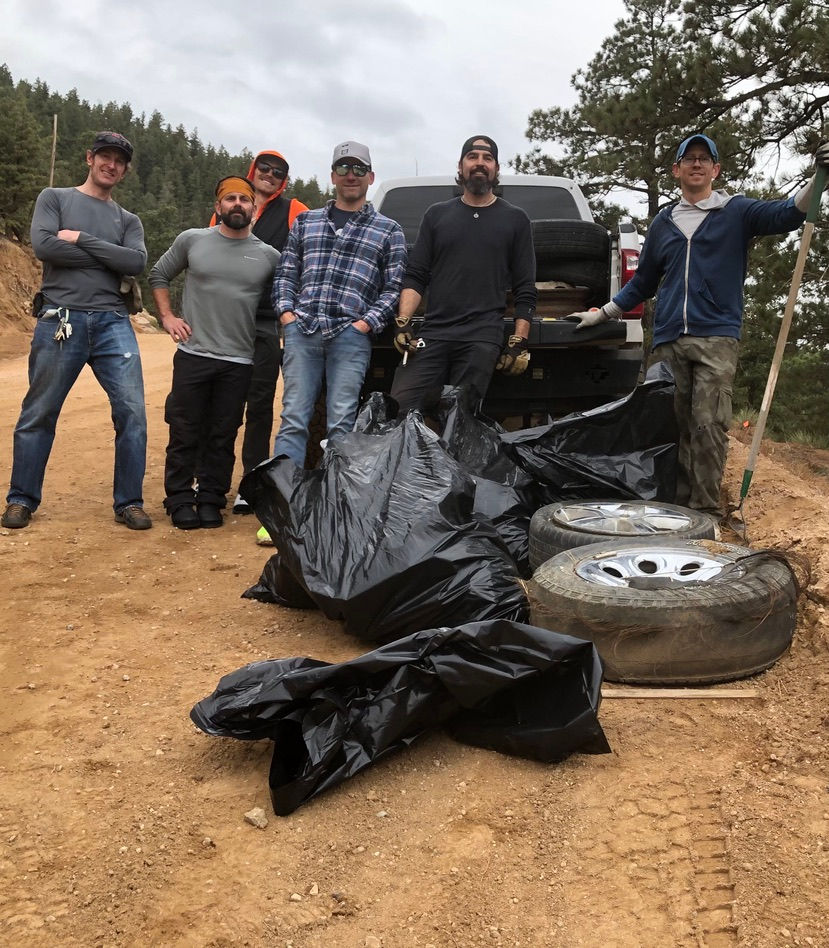
Dakota and Sam also appreciate the unique dichotomy of the Old Stage experience. “The area is very interesting, having you drive from one of the wealthiest neighborhoods in the Springs (The Broadmoor) to a blue-collar back road where people dump washing machines and shoot them from the road,” said Dakota. The abandoned vehicles and trash dumps are a constant fight for the governmental agencies charged with overseeing the road, and at times, it seems they are losing that fight. Shooting along the road was recently banned, but only time will tell if that is enforced well enough to deter anyone. Sam once had a close call with those shooters. “I once learned I was behind an active shooting range when I heard gunshots and subsequent bullets whizzing over my head when coming back from a day on Little Chief.”
One theory that Sam and Dakota have voiced, which I believe has merit, is that an influx of climbers can actually have a positive impact on the environment by changing the culture. “A large portion of the current user group clearly has little to no reverence for the land up there,” says Sam. “I see climbers spearheading cleanups and taking up the mantle of stewarding, protecting, and preserving access to the forest.”
A Bright Future
For those of you who grew up in the Springs with outdoor-minded parents, Old Stage Road likely features prominently in your childhood memories. Brent Law moved to the area as an infant and has spent countless hours cruising the roads and searching for quiet spots among the furs and pines. Sometimes, to the detriment of his education.

Brent is many times removed from the early generations that explored the crags lining the southern aspects of Pikes Peak, but he embodies many of the same qualities as those who explored during the golden age of the 70s. He works enough to pay for food, gas, and gear, but prefers to leave ample time for living life the way he wants. And that means climbing as often as possible.
The quiet recesses of the area have been a source of personal growth for Brent, as they have for so many. “Once I discovered what Old Stage had to offer, it became the center of my attention and definitely my most frequented area.” Over the course of a few years, Brent went from spending the better part of a day getting up the Martyr to now developing his own test pieces.
Old Stage Road has always been a place of disparate experiences. Wild, yet easily accessible. Beautiful, yet scarred. Steeped in history, yet constantly rewritten. Early pioneers wandered the steep valleys and peaks without maps, while today’s climbers find their way with Caltopo and scroll through beta on Mountainproj while racking up. The experience has evolved, but the draw remains the same. This new guidebook doesn’t just document history; it captures a living landscape and a community in constant change. If Sam and Dakota get it right, which I believe they will, it won’t just make climbing more accessible; it will help preserve a culture that both honors the past while taking responsibility for the future. Hell, maybe that’s the true promise of “The Stage”: it’s not just a first adventure, but a place you return to, again and again, to see who you’ve become.
Check in at Alpine Ethos for updates on when you can grab a copy at Mountain Chalet in Colorado Springs.


Great write-up, Phil! I loved it! Very well said! The new guidebook will be awesome!
I spent a fair amount of time at Big Chief in the 70's,Did the first ascent of the big dihedral in the first picture with Earl Wiggins in 1975 or so,named it Solid Air but don't know if it got changed. Did the first of the little peapod thing as well. Keith Angus did the first ascent of Dangling Participle, the big chock stone. Did an offwidth and hand crack with him as well but can't remember the name of it. Bob Robertson did the first ascent of Australian Flyer.